Dinah Grebs
The Robot Who Looked Like MeDinah Grebs is the efficient secretary of Clandestine Computer Services and the person who secretly engineers her appearance among Peter Honorious’s marriage candidates. Her story exposes the limits of the state’s attempt to make marriage calculable: a computer can preview years of a possible relationship, but it cannot explain or replace the feeling that prompts Dinah to pursue Honorious in the first place. Her intervention is at once an act of personal determination and a disruption of the orderly selection process on which the service depends.
Identity and Place in the Service
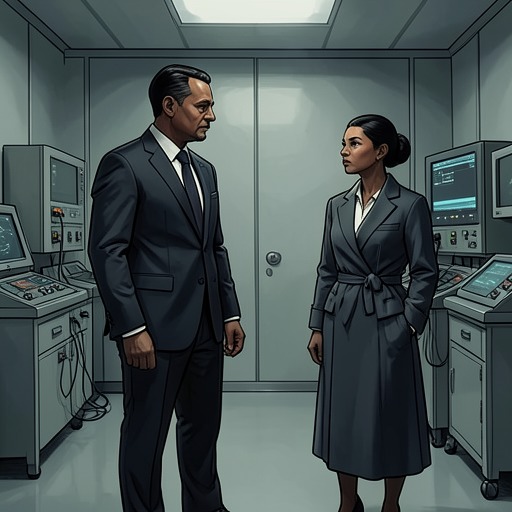
Dinah first appears at the entrance to Euler’s private office, where she shows Peter Honorious in. The company is temporarily operating from dusty offices in the derelict Lincoln Center area under the cover name Used Softwear Jobbers, Inc. Its hidden business is matchmaking by computer, and Dinah is not merely an anonymous part of its machinery: she is the secretary who brings clients into contact with it. She is described as pretty and efficient, an economical introduction that links professional competence with the personal desirability the company’s business evaluates.
The service’s surroundings establish the distance between its polished promises and its improvised reality. Its concealed computer is later installed in the back of a furniture van at a used-car lot on DeKalb Avenue. Dinah takes Honorious there, where two technicians disguised as derelicts lead him into a blacked-out room and attach psychometallic electrodes to his forehead and wrists. She is therefore both a familiar human intermediary and an operator in a clandestine process that turns prospective intimacy into a data-driven experience.
The Candidate and the Computer
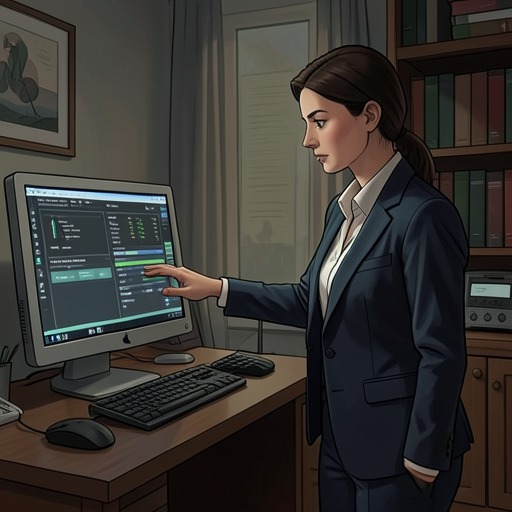
During the computer session, Dinah handles the candidate cards and tells Honorious that five years of events will be compressed into ten minutes of real time. When he says to take the top card, she feeds it into the terminal. The episode establishes her direct role in presenting the simulated futures, though it does not identify the woman in that first vision as Dinah. Later, after Honorious has chosen candidate number 6903, Euler uses the Public Records Machine to identify her as Dinah Grebs, of 4885 Railroad Street, Flushing, Queens.
The discovery makes the candidate list suddenly personal. Dinah has not simply been the employee guiding Honorious through an impersonal service: her own card has entered the pool from which he is choosing. Euler immediately asks how it got there. Dinah refuses to explain in front of him, saying that she will tell Honorious alone. That insistence changes the balance of the scene. The secretary who had ushered a client through the company’s process now claims a private conversation outside her employer’s authority.
Her Pursuit of Honorious
After Euler leaves, Dinah tells Honorious that she fell for him the first time he came to the office. She says she recognized them as a good match without needing the computer, while the high-class matrimonial service would not even process her card and Honorious had never looked at her. Her account supplies the personal reason for her intervention: she wanted him and acted to put herself within reach of the selection process. She insists that she has nothing to be ashamed of, presenting her action not as a technical error but as a choice made in response to a system that excluded her.
The exact means by which Dinah got her card into Honorious’s list is not explained. The narrative leaves that practical detail open even as it makes her motive explicit. Honorious initially answers in the language of legal entitlement and compensation: he says she has no valid legal claim on him, but offers a reasonable cash settlement for her time and trouble. Dinah then mocks the arrangement, telling him that any of the other candidates will suit his simpleminded needs and recommending the one who does not talk. Her sarcasm turns the service’s selection logic back on him, reducing its supposedly sophisticated assessment of marriage to a choice among compliant options.
Confrontation and Uncertain Future
The argument becomes physical without resolving into a neat romantic declaration. Honorious moves closer after cursing; Dinah swings at him, and he catches her wrist. They end up in contact, breathing hard, and looking at one another. The narration describes love as the unofficial heart of pair-bonding: a force that cannot be predicted, overrides other directives, and sets the state’s mating machinery in motion. Dinah’s experience thus supplies the plot’s counterexample to the computer’s authority. She has acted on a feeling the system could neither authorize nor forecast, while the encounter itself leaves open whether that feeling is returned.
Later, Honorious asks whether their projected future was real or whether Dinah altered her own data. His question keeps both the technology and Dinah’s intervention in play: the future he experienced may be a prediction, an engineered result, or something he has not yet learned how to judge. Dinah does not settle the uncertainty. She tells him, “You’ll just have to wait and find out,” a reply that leaves their relationship pending rather than validating it through either law or machinery. Her ending is therefore an open one: the computer has supplied an image of a possible future, but the two people involved must still discover what that future means.